
Виктор Суворов. Советская Армия: взгляд изнутри (engl)
страница №7
 ...ch of 1 tank and 4 motor-rifle divisions,
with 1 tank division in reserve.
In Romania there are 2 tank and 8 motor-rifle divisions--these will
also form a Front of two standard Armies together with an Air Army.
In Bulgaria there are 2 tank and 8 motor-rifle divisions.
In the second echelon is the Carpathian Military District, consisting
of the 58th Air Army and the 13th and 38th Armies. We already know that the
staff of the 8th Guards Tank Army has no one under its command and is to
move to Czechoslovakia in the event of war. Having made this assumption and
after moving one motor-rifle division forward 200 metres, the Front will
have 3 tank and 8 motor-rifle divisions--2 Armies with one division in
reserve.
Finally, in the third echelon, there is the Kiev Military District, in
which are located the staff of the C-in-C of the Strategic Direction and the
Group of Tank Armies (the 3rd and 6th Guards Tank Armies, with a total
complement of 8 tank divisions).
In reserve the C-in-C has two tank divisions (in Hungary and
Czechoslovakia) four motor-rifle divisions and the 102nd Guards Airborne
division. In addition he has a diversionary regiment and the variety of
supporting formations and units which the C-in-C of the Western Strategic
Direction also has.
Of course, it is no accident that the Group of Tank Armies is located
in the Kiev Military District. From here the Group can move quickly forward
to the Front by which it is most needed. But it could also be quickly
brought under the command of the Western Strategic Direction and, by
violating the neutrality of Austria from Hungary, could attack the
undefended Austro-German frontier.
2
The proportions laid down for the South-Western Direction are observed
as precisely as those of its Western counterpart.
In each Army there are 4 motor-rifle divisions and 1 tank division. In
the Strategic Direction there are 4 All-Arms Fronts and 1 Group of Tank
Armies.
In each Front there are 2 tank and 8 motor-rifle divisions. In all
there are 2 Tank Armies and 8 All-Arms Armies made up of 16 tank and 32
motor-rifle divisions. You will recall that in the Western Direction there
are 32 tank and 32 motor-rifle divisions.
The South-Western Strategic Direction can be strengthened with forces
from the Odessa and North Caucasus Military Districts.
Part Four
Mobilisation
Types of Division
1
The Soviet Army is armed with dozens of types of artillery weapons:
guns, howitzers, gun-howitzers, and howitzer-guns, ordinary and automatic
mortars, multi-barrelled, salvo-firing rocket launchers, anti-tank and
anti-aircraft guns. In each of these classes of weapons there is a whole
array of models--from very small to very large--and most of these exist in
many variants--self-propelled, auxiliary-propelled, towed, assault, mountain
and static.
But despite the wide variety of artillery systems, all of these have
one feature in common; no matter how many men there are in the crew of a
gun--three or thirty--only two qualified specialists--the commander and the
gunlayer--are needed. All the rest of the crew can perform their duties
without any kind of specialised training. Any No 2 loader, rammer number,
fuse-setter, ammunition handler or other member of a gun's crew, can have
his duties explained in three minutes and the crew can be working like
automata within a few hours. The same applies to the driver of a
self-propelled gun or of a gun tractor. If he was previously a tractor
driver he too will quickly master his new functions.
Soviet generals know that it is possible to teach a bear to ride a
bicycle--and very quickly. Why, they reason, do we need to maintain a
peacetime army of hundreds of thousands of soldiers whose wartime tasks
would be so simple? Surely it is easier to replace the thirty men in a
two-gun howitzer platoon with five--the platoon commander, two
gun-commanders and two loaders and to moth-ball both guns and their
tractors? If war comes, the others--the bears--can be trained very quickly.
For the present let them occupy themselves with peaceful work--casting steel
(armoured, of course) or building electrical power-stations (for the
production of aluminium, which is used only for military purposes in the
USSR).
2
In peacetime the great majority of Soviet artillery regiments, brigades
and divisions therefore have only 5% of the soldiers they would need in
wartime. Only those units (an insignificant minority) stationed in the
countries of Eastern Europe or on the Chinese frontier are up to full
strength.
This principle applies not only to the artillery but to most of the
land forces and indeed to the bulk of the whole Soviet Armed Forces. It is
almost impossible to apply it to certain categories--to tank forces or to
submarines say. But it does apply in many cases, particularly to the
infantry, to the marine infantry, to repair, transport and engineer
sub-units and to units manning Fortified Areas.
Because of this, the enormous Soviet land forces, with their peacetime
strength of 183 divisions as well as a very large number of independent
brigades, regiments and battalions, have a laughably small numerical
strength--little more than one and a half million men.
This astonishingly small figure is deceptive. Simply bringing the
existing divisions and the independent brigades, regiments and battalions up
to strength on the first day of mobilisation will raise the strength of the
land forces to 4,100,000. But this is just the first stage of mobilisation.
3
Soviet divisions are divided into three categories, depending on the
number of `bears' absent in peacetime:
Category A--divisions which have 80% or more of their full strength
Category B--those with between 30% and 50%
Category C--those with between 5% and 10%
Some Western observers use categories 1, 2 and 3 in referring to Soviet
divisions. This does not affect the crux of the matter, but is not quite
accurate. Categories 1 to 3 are used in the USSR only when referring to
military districts. Divisions are always referred to by letters of the
alphabet. This is because it is simpler to use letters in secret
abbreviations. For instance, `213 C MRD' refers to the 213th motor-rifle
division, which falls in category C. The use of a numerical category in such
a message could lead to confusion. In referring to military districts, which
have titles but no numbers, it is more convenient to use figures to indicate
categories.
Some Western observers overestimate the number of soldiers on the
strength of category B and C divisions. In fact there are considerably fewer
soldiers than it would appear to an outside observer. These overestimates
presumably result from the fact that in many military camps, in addition to
the personnel of divisions which are below strength, there are other
sub-units and units, also below strength but not included in the complement
of the division. The Soviet land forces have some 300 independent brigades,
more than 500 independent regiments and some thousands of independent
battalions and companies, which do not belong to divisions. In most cases
their personnel are quartered in the barracks of divisions which are below
strength, which gives a misleading impression of the strength of the
division itself. In many cases, too, for camouflage purposes, these
sub-units wear the insignia of the divisions with which they are quartered.
This applies primarily to rocket, diversionary and
reconnaissance/intelligence personnel but is also the case with units
concerned with the delivery, storage and transport of nuclear and chemical
weapons.
About a third of the divisions in the Soviet Army fall into category A.
They include all divisions stationed abroad and a number of divisions on the
Chinese frontier.
Categories B and C, too, account for approximately a third of all
Soviet divisions. In recent years there has been a constant shift of
divisions from category B to category C, because of the introduction of such
new arms of forces as airborne assault troops and fortified area troops. The
new sub-units and units need entirely new troops, which are always taken
from category B divisions. They cannot be taken from category A divisions,
because these represent the minimum number of troops who must be kept at
readiness, or from category C divisions because these have no one to spare.
It must also be noted that in category B divisions the three most
important battalions--rocket, reconnaissance and communications are kept at
category A strength. In category C divisions these battalions are maintained
at category B strength.
The same applies to similar sub-units serving with Armies and Fronts.
All rocket, reconnaissance, diversionary and communications sub-units of
Armies and Fronts are maintained at a strength one category higher than that
of all the other elements of the particular Army or Front.
4
It must be emphasised that the category allocated to a division has no
effect whatsoever upon the extent to which it is supplied with new weapons.
Divisions stationed abroad, which are all, without exception, in category A,
take second place when new combat equipment is being issued.
The newest equipment is issued first of all to the frontier Military
Districts--Baltic, Byelorussian, Carpathian, Far Eastern and Trans-Baykal.
Only five or seven, sometimes even ten years after a particular piece
of equipment has first been issued, is it supplied to divisions stationed
abroad. Third to be supplied, after them, are the Soviet Union's allies.
Once the requirements of all these three elements have been fully satisfied,
the production of the particular model is discontinued. Once production of a
new version has begun, the re-equipment of the frontier military districts
begins once again, and the material withdrawn from them is used to bring
units located in the rear areas up to the required scale. Once the Soviet
frontier military districts have been re-equipped, the process of supplying
their used equipment to Category C divisions follows. Then the whole process
begins again--to the second echelon, then to the first, then from the second
via the first to the third.
Such a system of supplying combat equipment has undeniable advantages.
Firstly, secrecy is greatly increased. Both friends and enemies assume
that the equipment issued to the Group of Forces in Germany is the very
latest available. Enemies therefore greatly underestimate the fighting
potential and capabilities of the Soviet Army. Friends, too, are misled and
it therefore becomes possible to sell them a piece of equipment which is
being issued in East Germany as if it were the most up-to-date model.
Secondly, it becomes far more difficult for a Soviet soldier to defect
to the enemy with details of the newest equipment--or even, perhaps, to
drive across the border in the latest tank or fighting vehicle. It is
practically impossible to do this from the Baltic or Byelorussian Military
Districts. The Soviet command does not worry at all about the Trans-Baykal
or Far Eastern Military Districts. It knows very well that every Soviet
soldier hates socialism and that he would therefore defect only to one of
the capitalist countries. No one would ever think of defecting to socialist
China.
Thirdly, in the event of war, it is the first echelon forces which
would suffer the greatest losses in the first few hours--good equipment must
be lost, of course, but it should not be the very latest. But then, after
this, the Carpathian, Byelorussian and Baltic divisions go into battle
equipped with the new weapons, whose existence is unsuspected by the enemy.
This system of re-equipment has been in existence for several decades.
It is significant that the T-34 tank, which went into mass production as
early as 1940, was issued only to military districts in the rear areas.
Although the USSR was unprepared for Germany's surprise attack, these
security measures were taken automatically, simple as they were to enforce.
The surprise onslaught made by the Germans destroyed thousands of Soviet
tanks, but there was not a single T-34 among them. Nor, despite the fact
that the Soviet Army had some 2,000 of these tanks, did they appear in
battle during the first weeks of the war. It was only after the first
echelon of the Soviet forces had been completely destroyed, that the German
forces first met the excellent T-34. It is also significant that German
Intelligence did not suspect even the existence of that tank, let alone the
fact that it was in mass production.
The Invisible Divisions
1
On 31 December, 1940, the German General Staff finished work on a
directive on the strategic deployment of the Wehrmacht for the surprise
attack on the USSR. A top-secret appendix to the directive was prepared from
data provided by German Intelligence, containing an appreciation of the
fighting strength of the Red Army. The German generals believed that the
Soviet land forces possessed 182 divisions, of which only 141 could be
brought into a War against Germany. Because of the tense situation on the
Asian frontiers of the USSR, a minimum of 41 divisions must at all costs be
left guarding these frontiers. The whole plan for the war against the USSR
was therefore based on an estimate of the speed with which 141 Soviet
divisions could be destroyed.
On 22 June Germany attacked, taking everyone in the USSR, Stalin
included, by surprise. The way the war developed could not have been better
for Germany. In the first few hours, thousands of aircraft were blazing on
Soviet airfields while thousands of Soviet tanks and guns did not even
succeed in leaving their depots. In the first days of the war, dozens of
Soviet divisions, finding themselves encircled and without ammunition, fuel
or provisions, surrendered ingloriously. German armoured spearheads carried
out brilliant encirclement operations surrounding not just Soviet divisions
or corps but entire Armies. On the third day of the war the 3rd and the 10th
Soviet Armies were surrounded near Bialystok. Immediately after this an
equally large encirclement operation was carried out near Minsk, Vitebsk and
Orsha, near Smolensk. Two Soviet armies were destroyed after being
surrounded near Uman' and five Armies in a huge pocket near Kiev.
However, already, even while the bells were ringing for their
victories, the sober-minded German generals were biting their fingernails,
as they bent over maps; the number of Soviet divisions was not
diminishing--on the contrary, it was rising fast. Already in mid-August
General Halder was writing in his diary: `We underestimated them. We have
now discovered and identified 360 of their divisions!' But Halder was only
talking about the Soviet divisions which were directly involved at that
moment in fighting in the forward areas--that is, first echelon divisions.
But how many were there in the second echelon? And in the third? And in the
reserves of the Armies and the Fronts? And in the internal military
districts? And in the Stavka's reserve? And how many divisions had the NKVD?
How many were there in all?
The miscalculation proved fatal. 153 German and 37 allied divisions
proved insufficient to destroy the Red Army, even given the most favourable
conditions.
The German generals' miscalculation was twofold. Firstly, the Red Army
consisted, not of 182 but of 303 divisions, without counting the divisions
of the NKVD, the airborne forces, the marine infantry, the frontier troops,
the Fortified Area troops and others.
Secondly, and this was most important, the German generals knew
absolutely nothing about the `second formation' system--the system which
splits Soviet divisions into two in the course of one night. This is a
system which enables the Soviet General Staff to increase the number of its
divisions by precisely one hundred per cent, within a remarkably short time.
2
The system of `invisible' divisions was adopted by the Red Army at the
beginning of the 1930s. It saved the Soviet Union from defeat in the Second
World War. It is still in use today.
The process, which enables the Soviet leadership to expand the fighting
strength of its Armed Forces with great speed, is simple and reliable and
uses almost no material resources.
In peacetime every divisional commander has not one but two deputies.
One of these carries out his duties continuously, the other does so only
from time to time, since he has an additional series of responsibilities. He
also has a secret designation--`Divisional Commander--Second Formation'.
The chief of staff of a division, a Colonel, also has two deputies,
Lieutenant-Colonels, one of whom also has a secret designation--`Divisional
Chief of Staff--Second Formation'.
The same system applies in every regiment.
Every battalion has a commander (a Lieutenant-Colonel) and a deputy,
who is secretly designated `Battalion Commander--Second Formation'.
Let us imagine that a conflict has broken out on the Soviet-Chinese
frontier. A division receives its stand-to signal and moves off immediately
to its operational zone. The divisional commander has only one deputy--the
officer who has been carrying out this function, with all its
responsibilities, in peacetime. His chief of staff and his regimental
commanders, too, have only one deputy apiece. The battalion commanders have
no deputies, but in a situation of this sort one of the company commanders
in each battalion immediately becomes deputy to the battalion commander and
one of the platoon commanders automatically takes his place.
Such unimportant moves of officers do not reduce the fighting
efficiency of the division in any way.
So, the division leaves its camp at full strength, with all its
soldiers and equipment. If it has less than its complement of soldiers and
junior officers, it will be brought up to strength as it moves to the
operational zone. The absorption of reservists is an operation which has
been very carefully worked out.
However, after the departure of the division the military camp is not
left empty. The Colonel who functioned as deputy to the division's chief in
peacetime has remained there. There, too, are six Lieutenant-Colonels, who
were the deputies of the regimental commanders, together with the deputy
battalion commanders and with one third of the platoon commanders, who now
become company commanders.
Thus, an entire command staff remains in the camp. Their previously
secret titles become overt. Within twenty-four hours this new division
receives 10,000 reserve soldiers and the military camp from which one
division has only just set out is already occupied by a new one.
Unquestionably, of course, the new division is inferior in fighting power to
the one which has just departed for the front. Of course, the reservists
have long ago forgotten what they were taught during their army service many
years earlier. It is understandable that the platoons, companies and
battalions have not shaken down and are not yet capable of obeying the
orders of their commanders promptly and accurately. Nevertheless, this is a
division. At its head is a trained and experienced officer who for several
years has been, essentially, an understudy to the commander of a real
operational division and who has often performed the latter's functions.
Those in command of the new regiments, battalions and, companies, too, are
all operational officers, rather than reservists. Each of them has worked
constantly with real soldiers and with up-to-date equipment, has taken part
in battle exercises and has borne constant, heavy responsibility for his
actions and for those of his subordinates. In addition, all the officers of
the new division from the commander downwards know one another and have
worked together for many years.
But where does enough equipment for so many new divisions come from?
This question is simple. These `invisible' divisions use old equipment. For
instance, immediately after the end of the war, Soviet infantrymen were
armed with PPSh automatic weapons. These were changed for AK-47 assault
rifles. Each division received the number of new weapons which it needed and
the old ones were mothballed and stored in the division's stores for the
`invisible divisions'. Then the AKM rifle replaced the AK-47s, which were
taken to the divisional store, from which the old PPSh weapons were sent
(still fit for use) to government storehouses or were passed on to `national
liberation movements'. The same path has been followed by the RPG-1, RPG-2,
RPG-7 and then the RPG-16 anti-tank rocket launchers. As new weapons were
received, those of the previous generation remain in the division's store,
until the division receives something completely new. Then the contents of
the store are renewed.
The same happens with tanks, artillery, communications equipment and so
forth. I have myself seen, in many divisional stores, mothballed JS-3 tanks
(which were first issued to units at the end of the Second World War) at a
time when the whole division was equipped with the T-64, which was then
brand new. When the Soviet artillery began to be re-equipped with
self-propelled guns, the old, towed guns were certainly not sent away to be
melted down. They were mothballed for the `second formation division'.
So, you say, these `invisible divisions' are not only staffed with
reservists who have grown fat and idle, but are equipped with obsolete
weapons? Quite correct. But why, Soviet generals ask, reasonably, should we
issue fat reservists with the latest equipment? Would they be able to learn
to use it? Would there be enough time to teach them in a war? Is it not
better to keep the old (in other words simple and reliable) equipment, which
is familiar to the reservists? Weapons which they learned to use eight or
ten years ago, when they were in the army? Mothballing an old tank is a
thousand times cheaper than building a new one. Is it not better to put ten
thousand old tanks into storage than to build ten new ones?
Yes, the `invisible divisions' are old-fashioned and they don't bristle
with top-secret equipment, but it costs absolutely nothing to maintain 150
of them in peacetime. And the arrival of 150 divisions, even if they are
old-fashioned, at a critical moment, to reinforce 150 others who are armed
with the very latest equipment, could nonplus the enemy and spoil all his
calculations. That is just what happened in 1941.
The system of `second formation' is not restricted to the land forces.
It is also used by the airborne forces, the frontier troops, the marine
infantry, in the Air Forces and by the National Air Defence Forces.
Here is an example of the use of this system.
At the end of the 1950s the anti-aircraft artillery regiments and
divisions of the National Air Defence Forces began to be rapidly re-equipped
with rocket weapons, in place of conventional artillery. All the
anti-aircraft guns were left with the anti-aircraft regiments and divisions
as secondary weapon systems, in addition to the new rockets. It was intended
that, in the event of war, an anti-aircraft artillery regiment could be set
up as a counterpart to each anti-aircraft rocket regiment and that the same
could be done with each anti-aircraft rocket brigade and division.
Khrushchev himself came out strongly against the system. Those commanding
the National Air Defence Forces suggested that Khrushchev should withdraw
amicably but Khrushchev refused, rejecting what he saw as a whimsical idea
by a handful of conservative generals who were unable to understand the
superiority of anti-aircraft rockets over obsolete anti-aircraft guns. But
then the war in Vietnam began. Suddenly, it was realised that rockets are
useless against aircraft which are flying at extremely low altitudes. It
also became clear, that there are conditions in which it is quite impossible
to transport rockets into certain areas, that during mass attacks it is
almost impossible for rocket launchers to reload so that after the first
launch they are completely useless, that the electronic equipment of rocket
forces is exposed to intense countermeasures by the enemy, and that those
may seriously reduce the effectiveness of missile systems. It was then that
the old-fashioned, simple, reliable, economical anti-aircraft guns were
remembered. Thousands of them were taken out of mothballs and sent to
Vietnam to strengthen the anti-aircraft rocket sub-units. The results they
achieved are well known.
This makes it quite clear why old anti-aircraft guns (tens of thousands
of them) are still stored, today, by the anti-aircraft rocket sub-units of
the Soviet Army. All of them have already been collected together for the
`invisible' regiments, brigades and divisions. If it should become
necessary, all that needs to be done is to call upon those reservists who
have once served in units equipped with these systems and the numerical
strength of the National Air Defence Forces will be doubled. Of course, its
fighting strength will not be increased in proportion to this numerical
growth, but in battle any increase in strength may change the relative
positions of the combatants.
Why is a Military District commanded by a Colonel-General in peacetime, but only by a Major-General in wartime?
1
No single aspect of the organisation of the Soviet Army gives rise to
so many disagreements and misunderstandings among specialists as the
question of Military Districts. One expert will assert that a district is
under the command of the Commander-in-Chief of Land Forces. Others will
immediately reject this. The commander of a military district has an Air
Army at his disposal and he is in command of it, but the C-in-C Land Forces
is not entitled to exercise command over an Air Army. The commander of a
military district may have naval, rocket or flying training schools in his
area and he must command them, but the C-in-C Land Forces has no authority
over such institutions. In order to understand the role of the military
district in the Soviet Army, we must once again return to wartime and
remember what its function was then.
Before the war, the territory of the Soviet Union was divided into 16
military districts. The same organisational structure still exists today,
with minor changes. Before the war military districts were commanded by
Colonel-Generals and Generals of the Army. Today the situation remains
exactly the same. During the war the forces from these districts went to the
front, under the command of these same Colonel-Generals and Generals. But
the military districts remained in existence. During the war they were
commanded by Major-Generals or, in a few instances, by Lieutenant-Generals.
During the war the military districts were nothing but territorial
military administrative units. Each military district was responsible for:
Maintaining order and discipline among the population, and ensuring the
stability of the Communist regime.
Guarding military and industrial installations. Providing and guarding
communications.
Mobilising human, material, economic and natural resources for use by
the fighting armies.
Training reservists.
Mobilisation.
Of course these activities did not fall within the scope of the C-in-C
Land Forces. For this reason, the military districts were subordinated to
the Deputy Minister of Defence and through him to the most influential
section of the Politburo. The military districts contain training schools
for all Services and arms of service and it is in these that new formations
for all the Armed Services are assembled. For example, ten armies, one of
them an Air Army, were formed in the Volga Military District during the war,
together with several brigades of marine infantry, one Polish division and a
Czech battalion. In any future war, the military districts would perform the
same function. While military units and formations were being assembled and
trained they would all come under the orders of the commander of the
military district. He would himself be responsible to the C-in-C Land Forces
for all questions concerning the latter's armies, to the C-in-C of the Navy
on all matters concerning marine infantry, for air questions to the C-in-C
of the Air Forces and for questions relating to foreign units to the C-in-C
of the Warsaw Treaty Organisation. Because the overwhelming majority of the
units in a district comes from the Land Forces, it has come to be believed
that the C-in-C Land Forces is the direct superior of the commanders of the
military districts. But this is a misapprehension. Each C-in-C controls only
his own forces in any given military district. He has no authority to become
involved in the wide range of questions for which the commander of a
military district is responsible, in addition to the training of reservists.
As soon as new formations have completed their training, they pass from the
responsibility of the commander of the military district to the Stavka and
are sent to the front. Thus, the commander of a military district is simply
the military governor of a huge territory. As such, he is in command of
every military formation located on his territory, whichever Armed Service
it comes from.
2
At the end of the war staffs and fighting units would be dispersed
throughout the country in accordance with the plans of the General Staff. It
would be normal for a Front, consisting of a Tank, an Air and two All-Arms
Armies to be located in a military district. By virtue of his position, the
Front Commander, who has the rank of Colonel-General or General of the Army,
is of considerably greater importance than the wartime commander of a
military district. In peacetime, in order to avoid bureaucracy and
duplication, the staffs of the Front and of the military district are
merged. The Front Commander then becomes both the military and the
territorial commander, with the peacetime title of Commander of the Forces
of the District. The general, who acted as a purely territorial commander
during the war, becomes the Deputy Commander of the district in peacetime,
with special responsibility for training. The Front's chief of staff becomes
the peacetime chief of staff of the district and the officer who held the
function in the district in wartime becomes his deputy.
Thus, in peacetime a military district is at one and the same time an
operational Front and an enormous expanse of territory. However, it can
split into two parts at any moment. The Front goes off to fight and the
district's organisational framework stays behind to maintain order and to
train reservists.
In some cases something which is either larger or smaller than a Front
may be located in a particular military district. For instance, only a
single Army is stationed in the Siberian Military District, while the Volga
and Ural Military Districts, too, have only one Army, which in both cases is
of reduced strength. In peacetime the staffs of these Armies are merged with
the staffs of the districts in which they are located. The Commanders of
these Armies act as district commanders while the generals who would command
the district in wartime function as their deputies. Since these particular
districts do not contain Fronts, they have no Air Armies. The C-in-C Land
Forces therefore has the sole responsibility for inspecting these troops and
this is what has led to the belief that these Districts are under his
command.
No two districts are in the same situation. The Kiev Military District
contains the staff of the Commander-in-Chief of the South-Western Strategic
District and a Group of Tank Armies. The staffs of the Kiev Military
District, of the Group of Tank Armies and of the C-in-C have been merged. In
peacetime, too, the C-in-C goes under the modest title of Commander of the
Kiev Military District. We have already seen how different the position is
in other districts.
In the Byelorussian Military District the staffs of the District and of
a Group of Tank Armies are merged. Although he has more forces than his
colleague in Kiev, the Commander of the District is nevertheless two steps
behind him, since he is not the C-in-C of a Strategic Direction but only the
Commander of a Group of Tank Armies.
In the Trans-Baykal Military District the District staff, that of the
C-in-C of the Far Eastern Strategic Direction and the staff of the Front are
merged.
Depending on the forces stationed on its territory, a military district
is assigned to one of three categories, category 1 being the highest. This
classification is kept secret, as are the real titles of the generals who,
in peacetime, each carry the modest title of Commander of a Military
District.
The System for Evacuating the Politburo from the Kremlin
1
The Kremlin is one of the mightiest fortresses in Europe. The thickness
of the walls in some places is as much as 6-5 metres and their height
reaches 19 metres. Above the walls rise eighteen towers, each of which can
defend itself independently and can cover the approaches to the walls.
In the fourteenth century the Kremlin twice withstood sieges by the
Lithuanians and during the fifteenth century the Mongolian Tartars made two
unsuccessful attempts within the space of fifty years to capture it.
After the Tartar yoke had been shaken off, the Kremlin was used as a
national treasury, as a mint, as a prison and as a setting for solemn
ceremonies. But the Russian Tsars lived in Kolomenskoye and in other
residencies outside the town. Peter the Great left Moscow altogether and
built himself a new capital, opening a window on Europe. An unheard-of
idea--to build a new capital on the distant borders of his huge country,
right under the nose of the formidable enemy with whom Peter fought for
almost his whole reign. And all in order to have contact with other
countries.
After Peter the Great, not a single Tsar built behind the Kremlin's
stone walls. Go to the capital he built, to Tsarkoye Syelo, to Peterhof, to
the Winter Palace, and you will note that all of them have one feature in
common--enormous windows. And the wider the windows of the imperial palaces
became, the more widely the doors of the empire were thrown open. The
Russian nobility spent at least half of their lives in Paris, some of them
returning home only long enough to fight Napoleon before rushing back there
as quickly as possible. After the 1860 reforms, a Russian peasant did not
even have to seek permission before emigrating. If he wanted to live in
America--well, if he didn't like being at home, to hell with him! Even today
in the United States and in Canada millions of people still cling to their
Slavonic background. Foreigners were allowed into the country without visas
of any sort--and not just as tourists. They were taken into Government
service and were entrusted with almost everything, given posts in the War
Ministry, the Ministry of Foreign Affairs, the Ministry of the Interior...
The ministries, the crown and the throne were entrusted to Catherine the
Great, who was honoured as the mother of the country, everybody having
forgotten that she was a German. There is no need even to mention the
freedom given to foreign business undertakings which set themselves up on
Russian territory. It was, in short, an idyllic state of affairs, or perhaps
not quite idyllic but certainly something entirely different to the state of
affairs which exists today.
Under Lenin, everything changed. He began by closing all the frontiers.
Before the First World War more than 300,000 people went to Germany alone,
each year, for seasonal work. Vladimir Ilyich soon put a stop to that. And
having closed the country's frontiers he soon became aware that it would be
no bad thing to shut himself away from the people behind a stone wall. He
suddenly thought of the Kremlin. Lenin realised quite clearly that he would
be shot at more often than the Emperors of Russia had ever been and without
a moment's hesitation he abandoned the wide windows of the imperial palaces
for the blank walls of the Kremlin.
Having shut his people in behind a wall of iron and having put a stone
one between them and himself, Lenin then took a precaution which had not
been resorted to in Russia for a thousand years. He brought in foreign
mercenaries to guard the Kremlin--the 4th Latvian rifles to be precise.
Lenin did not trust Russians with this job--he must have had his reasons.
These mercenaries claimed, as one man, that they were guarding Lenin
out of purely ideological motives, since they were convinced socialists.
Despite this, however, not one of them would acknowledge the validity of
Soviet bank notes; they demanded that Lenin should pay them in the Tsar's
gold. Thanks to Lenin, there was enough of this available. At the same time,
a brave preacher in Riga prophesied that the whole of free Latvia would one
day pay with its blood for these handfuls of gold.
The Kremlin also had a great appeal for Stalin, who inherited it from
Lenin. He strengthened and modernised all its buildings thoroughly. Among
the first of the changes he was responsible for was a series of large-scale
underground constructions--a secret corridor leading to the Metro, an
underground exit on to Red Square and an underground command post and
communications centre. Stalin threw Lenin's foreign mercenaries out of the
Kremlin. Many of them were executed straight away, others many years
later--before the seizure of Latvia itself.
Stalin chose to spend a large proportion of his thirty years in power
immured in the Kremlin. He also arranged for a number of underground
fortresses to be built in the grounds of his various dachas in the country
round Moscow. The most substantial of these was at Kuntsevo. His complex
pattern of movement between the Kremlin and these dacha fortresses enabled
Stalin to confuse even those closest to him about where he was at any
particular moment.
Stalin's system of governing the country and of controlling its armed
services is still in operation today. In peacetime all the threads still
lead back to the Kremlin and to the underground fortresses around Moscow. In
wartime, control is exercised from the control post of the High Command,
which, incidentally, was also built by Stalin.
2
It is quite impossible to acquire a plot of land in the centre of
Moscow--even in a cemetery. This is not surprising if you visualise a city
which contains seventy Ministries. For Moscow is not only the capital of the
Soviet Union but also of the RSFSR (Russian Soviet Federal Socialist
Republic), which means that it must house not only Soviet ministries but
dozens of republican ones as well. Besides these Moscow houses the KGB, the
General Staff, the Headquarters of the Moscow Military District, the
Headquarters of the Moscow District Air Defence Forces, the Headquarters of
the Warsaw Treaty Organisation, CMEA, more than one hundred embassies,
twelve military academies, the Academy of Sciences, hundreds of committees
(including the Central Committee), and of directorates (including the Chief
Intelligence Directorate--GRU), editorial offices, libraries, communications
centres, etc.
Each of these wishes to put up its buildings as close as possible to
the centre of the city and to build accommodation for its thousands of
bureaucrats as close to its main buildings as it can.
A fierce battle goes on for every square metre of ground in the centre
of Moscow and only the Politburo can decide who should be given permission
to build and who should be refused.
And yet, almost in the centre, a huge, apparently endless field lies
fallow. This is Khodinka, or, as it is known today, the Central Airfield. If
this field were built on there would be room for all the bureaucrats. Their
glass skyscrapers would rise right along the Leningradskiy Prospekt, which
runs into Gorky Street and leads straight to the Kremlin. Many people look
enviously at Khodinka musing about ways of cutting small slices out of
it--after all this `Central Airfield' is not used by aircraft: it simply
lies there, empty and idle.
For several years the KGB made efforts to acquire a small piece of land
at Khodinka. The Lubyanka could not be enlarged any further, but the KGB was
still growing. A vast new building was needed. But all attempts by the KGB
to persuade the Politburo to allocate it some land at Khodinka were
unsuccessful. That was how the huge new KGB building came to be built right
out beyond the ring-road--a highly inconvenient location. Meanwhile the
endless field still stretches through the centre of Moscow, lying empty as
it always has done. Once a year rehearsals for the Red Square military
parade are held there and then the field sinks back into lethargy. Naturally
this valuable piece of ground is not being kept just for these rehearsals.
The troops could be trained on any other field--there are enough of them
around Moscow.
Why does the Politburo refuse even the KGB, its favourite offspring,
permission to cut the smallest corner off this vast unused field? Because
the field is connected to the Kremlin by a direct underground Metro
line--Sverdlov Square (under the Kremlin
itself)--Mayakovskaya--Byelorusskaya--Dinamo--Aeroport. Muscovites know how
often and how quickly this line is closed during any kind of holiday or
celebration, or any other event which breaks the normal rhythm of life in
the Soviet capital.
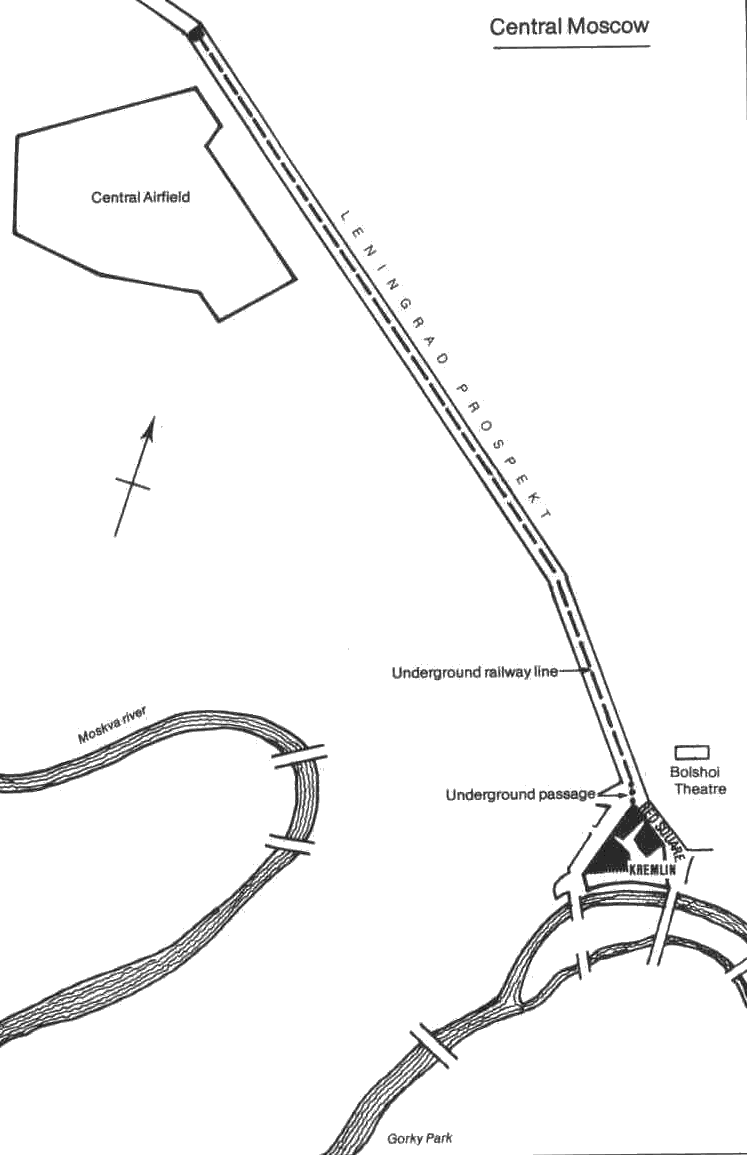
Why do the Soviet leaders particularly like this Metro line? Already
before the war many spacious underground halls had been built for Moscow
Metro stations and the ceremonies to mark the anniversary of the revolution,
on 6 November, 1941, were actually held in the Mayakovskiy Metro station.
Everyone invited to attend had to reach the station from above, because the
line had been closed. Once they were there a special Metro train appeared
carrying Stalin, Molotov and Beriya. They came from the Sverdlov Square
Metro station. To reach this, they do not, of course, leave the Kremlin.
They have their own secret corridor leading to the Metro from right inside
its buildings.
Stalin's route out of the Kremlin has existed unchanged for several
decades. If necessary, any or all of the members of the Politburo can be
taken underground, in complete secrecy and security, to Khodinka, where
government aircraft await them in well-guarded hangars. With normal
organisation, the Politburo can leave the huge, traffic-laden city within
fifteen minutes, during which no outsider will spot official cars speeding
along streets in the centre or helicopters flying out of the Kremlin.
North-west of Moscow is another government airfield--Podlipki.
(Incidentally, just beside this airfield is the centre at which cosmonauts
are trained.) The sub-unit stationed at Podlipki is known as the 1st Task
Force of the Civil Air Fleet. In fact it has virtually nothing to do with
the Civil Air Fleet--it is a group of government aircraft. Ordinary official
flights begin and end at Podlipki. Special official flights, involving
ceremonial meetings and escorts, make the brief flight to Sheremetyevo or to
one of Moscow's other large airports. In an emergency the Politburo could be
evacuated in various ways:
- from the Kremlin in official cars to Podlipki and from there by air
to the Supreme Command Post; this is a long and inconvenient route. In
addition all Moscow can see what is happening.
- from the Kremlin by Metro to Khodinka and from there by helicopter to
Podlipki; this too, is a fairly long route, involving as it does changing
from the helicopter to a fixed-wing aircraft.
- the shortest variation--an aircraft of the 1st Task Force of the
Civil Air Fleet is either permanently stationed at Khodinka or makes the
short flight there from Podlipki, takes the members of the Politburo on
board, and vanishes.
3
The special aircraft soars up into the early morning mist over sleeping
Moscow. As it gains height it makes a wide turn and sets course for the
SCP--the Supreme Command Post, built by Stalin and modernised by his
successors. Where is the SCP? How can it be found? Where would Stalin have
chosen to site it?
Most probably it is not in Siberia. Today the eastern regions are
threatened by China, as they were before the war by Japan. Of course the SCP
would not be located in any area which might be threatened, even
theoretically, by an aggressor, so it cannot be in the Ukraine, in the
Baltic region, in the Caucasus or in the Crimea. Common sense suggests that
it must be somewhere as far away as possible from any frontier--in other
words in the central part of the RSFSR, which could hardly be over-run by
enemy tanks and which could scarcely be reached by enemy bombers, or by
aircraft carrying airborne troops. And if hostile aircraft were to reach the
spot they could only do so without fighter cover, so they would be
defenceless.
Secondly, the SCP cannot, of course, be sited in an open field. There
must be a minimum of 200 metres of solid granite above its many kilometres
of tunnels and roads. This being so, it can only be in either the Urals or
Zhiguli.
Thirdly it stands to reason that it must be surrounded by natural
barriers which are so impenetrable that no hunter who happens to enter the
area, no geologist who loses his way, no gaol-breaker, no pilot who has
survived a crash and wandered for weeks through the taiga can come across
the SCP's huge ventilator shafts, descending into terrifying chasms or its
gigantic tunnels, their entrances sealed by armoured shields weighing
thousands of tons. If Stalin set out to keep the location of the SCP secret
he would not have chosen the Urals, whose gentle slopes were being
completely worn away by the feet of tens of millions of prisoners. Where
could one build a whole town, so that no trace of it would be found by a
single living soul? The only possible place is Zhiguli.
Would it be possible to find a better place, anywhere on earth, to
build an underground town? Zhiguli is a real natural miracle--a granite
monolith 80 kilometres long and 40 wide.
Some geologists maintain that Zhiguli is one single rock, crumbling
slightly at the edges but retaining the original, massive unity of all its
millions of tons.
It rises out of the boundless steppes, almost entirely encircled by the
huge river Volga, which turns it into a peninsula, with rocky shores which
stretch for 150 kilometres and fall sheer to the water's edge. Zhiguli is a
gigantic fortress built by nature, with granite walls hundreds of metres
high, bounded by the waters of the great river. From the air, Zhiguli
presents an almost flat surface, overgrown with age-old, impenetrable
forest.
The climate is excellent--a cold winter, with hard frosts, but no wind.
The summer is dry and hot. This would be the place to build sanatoriums!
Here and there in clearings in the virgin forests there are beautiful
private houses, fences, barbed wire, Alsatian dogs. One of Stalin's dachas
was built here, but nothing was ever written about it, any more than about
those at Kuntsevo or Yalta. In the vicinity were the villas of Molotov and
Beriya and later of Khrushchev, Brezhnev and others.
Anyone who has travelled on the Moscow Metro will say that there is no
better underground system in the world. But I would disagree with
this--there is a much better one. In Zhiguli. It was built by the best of
the engineers who worked on the Moscow Metro--and by thousands of prisoners.
In Zhiguli tens of kilometres of tunnels have been cut, hundreds of
metres deep into the granite monolith and command posts, communications
centres, stores and shelters have been built for those who will control the
gigantic armies during a war.
In peacetime, no aircraft may fly over this region. Not even the most
friendly of foreigners may enter the Zhiguli area, which is protected by a
corps of the National Air Defence Forces and by a division of the KGB.
Nearby is a huge airfield, at Kurumoch, which is completely empty. This is
where the special aircraft will land but it is also intended for use by
additional fighter aircraft, to strengthen the defences in the event of war.
Close to Zhiguli is the city of Kuybishev. It, too, is closed to
foreigners, and it is useful to remember that this was where the whole
Soviet government was based during the last war.
Part Five
Strategy and tactics
The Axe Theory
1
For decades, Western military theorists have...

